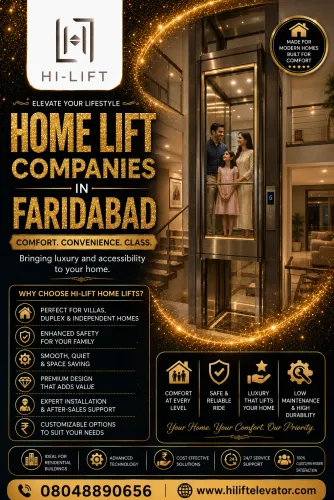

Residential lifts are increasingly considered during the design of villas, builder floors and multigenerational homes. They improve accessibility and make everyday movement easier for senior citizens, children and family members with mobility limitations. However, choosing among residential lift manufacturers in Gurgaon requires careful attention to space, safety and long-term serviceability.
A home elevator should complement the property without compromising structural safety or creating difficult maintenance requirements.
Decide Why the Lift Is Needed
The intended use shapes almost every technical decision. Some homeowners need a lift primarily for elderly family members, while others want convenient access between parking, living and terrace levels.
Consider who will use the elevator and what may need to travel inside it. A compact cabin may be suitable for two or three standing passengers but inadequate for a wheelchair, attendant or bulky household item.
Questions worth answering include:
- How many people will use it regularly?
- Is wheelchair access required?
- How many floors must it serve?
- Will it connect to the basement or terrace?
- Is the property new or already occupied?
- How much internal or external space is available?
- What electrical backup is available?
Clear answers allow the manufacturer to recommend a practical configuration.
Assess Space Before Choosing a Model
Marketing terms such as “space-saving” or “pitless” should not replace an actual site assessment. Each lift technology has specific requirements for the shaft, pit, overhead clearance, supporting structure and landing access.
In existing Gurgaon homes, the lift may be planned near the staircase, in a central atrium or along an exterior wall. Each position affects structural work, weather protection, entry orientation and interior circulation.
An architect or structural professional should confirm whether the proposed location can support the system. The manufacturer must then provide accurate drawings before civil or fabrication work begins.
Compare Drive Technologies Carefully
Residential elevators may use hydraulic, traction or other compact drive arrangements. No single technology is automatically best for every home.
Hydraulic systems can suit low-rise travel and certain space configurations, while traction-based systems may provide efficient operation and a different ride profile. Machine-room-less designs can reduce the need for a separate machinery area, but they still require suitable shaft and service access.
Instead of selecting technology based on a sales claim.
Instead of selecting technology based on a sales, compare:
- Space requirements
- Travel height and speed
- Ride comfort
- Noise levels
- Power requirements
- Emergency-lowering provisions
- Maintenance needs
- Availability of replacement components
The most appropriate option is the one that fits the property and expected usage.
Prioritise Home-Specific Safety
A residential lift may be used without a trained operator, making automatic safety features especially important.
Useful features include:
- Door interlocks
- Safety sensors
- Automatic rescue device
- Emergency alarm
- Backup lighting
- Overload protection
- Accurate floor levelling
- Emergency communication
- Child-conscious control placement
- Battery-supported lowering where applicable
Families should also prevent children from playing near landing doors or operating the lift unnecessarily.
Examine Design Without Ignoring Function
Cabin finishes can be coordinated with the home’s interiors through stainless steel, glass, laminates, lighting and flooring choices. Yet visual customisation should come after the technical specification is finalised.
Hi-Lift Elevator works with residential requirements across New Delhi, Gurgaon and surrounding NCR areas. When comparing any provider, homeowners should ask whether custom finishes can be supplied without affecting ventilation, capacity, maintenance access or safety performance.
Consider Maintenance Access and Support
A home lift must remain serviceable after interior work is complete. Decorative panels, false ceilings or landscaping should not block access to machinery, controllers or inspection areas.
Ask the manufacturer about preventive service frequency, local technician availability, emergency response and spare-part support in Gurgaon. The maintenance agreement should explain what is covered and which replacements are chargeable.
Residential elevator planning works best when it begins during the architectural stage. For an existing house, a detailed feasibility study becomes even more important. The ideal system is one that fits comfortably, operates safely and can be maintained without repeated disruption to the home.
Keywords