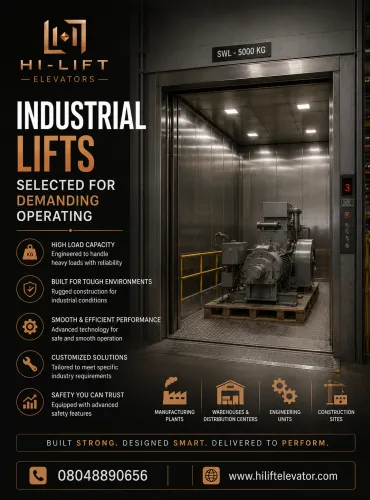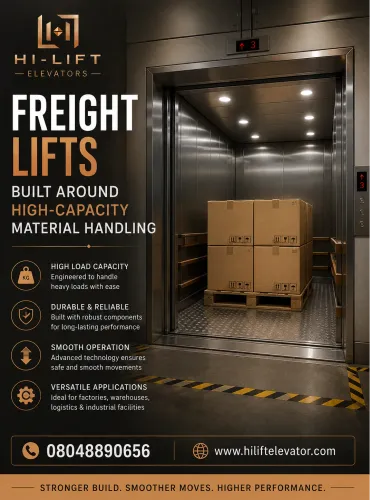
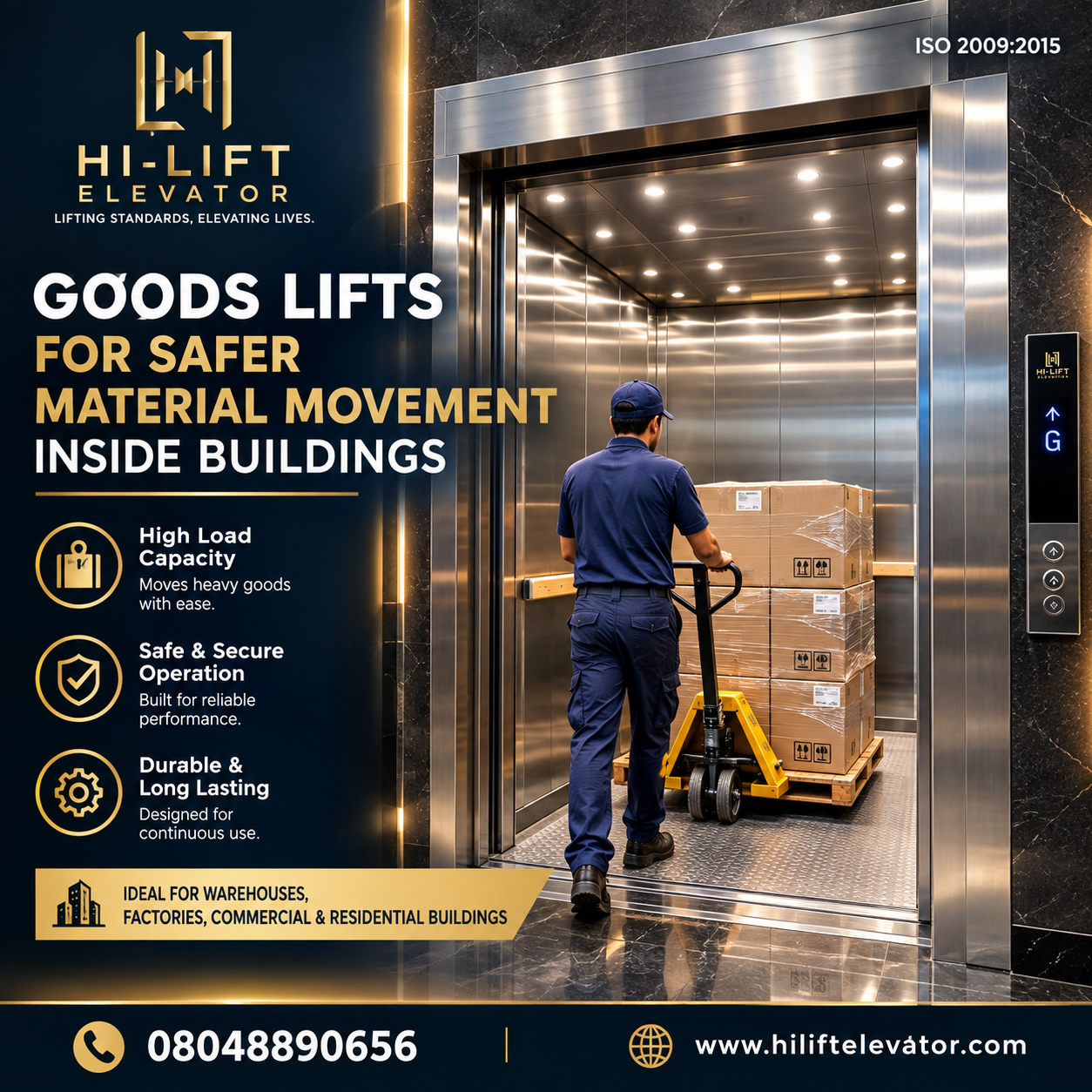
Moving cartons, stock, equipment, supplies, or other materials between floors manually can become inefficient as a property grows. Where vertical material movement is frequent, goods lifts can provide a purpose-designed alternative.
For warehouses, commercial properties, hospitality facilities, workshops, and other businesses in Faridabad, Haryana, the right goods lift depends primarily on what needs to be transported and how frequently the equipment will operate.
Goods Lift Selection Starts With the Load
A common mistake is choosing a lift before clearly defining the materials it must carry.
The planning process should establish:
- Maximum expected load
- Typical load dimensions
- Loading method
- Number of floors served
- Frequency of daily trips
- Required cabin dimensions
- Entrance dimensions
- Available shaft space
- Site operating conditions
A facility moving compact cartons has different requirements from one handling bulky equipment or loaded trolleys.
Capacity Should Include Future Requirements
Selecting capacity only around today's average load can limit future operations.
Businesses should consider whether production, storage, or inventory volumes may increase. However, unnecessarily oversizing the equipment can also affect investment and space requirements.
The objective is to choose a realistic rated capacity with an appropriate operational margin based on expected use.
Entrance Dimensions Are Easy to Overlook
Even when a cabin can accommodate the load, the material still needs to pass comfortably through the entrance.
Measure the widest and tallest items expected to be transported. If trolleys or handling equipment will be used, their complete loaded dimensions should be considered.
The loading area outside each landing also needs sufficient manoeuvring space.
Passenger Lifts Should Not Automatically Become Material Lifts
Using a passenger elevator for repeated movement of heavy or bulky materials can create practical problems.
Passenger cabins are primarily configured around people, while goods-oriented systems can be designed around material dimensions, rated loads, entrance requirements, operating frequency, and working conditions.
The appropriate lift category should be determined during planning.
Consider the Operating Environment
Industrial and commercial environments can expose lift equipment to dust, moisture, temperature variation, intensive usage, or other site-specific conditions.
These factors may influence material selection, component protection, electrical arrangements, cabin construction, and maintenance planning.
A site assessment can help identify such requirements before equipment is finalized.
Maintenance Protects Operational Continuity
When a goods lift forms part of daily logistics, downtime can disrupt workflows beyond the lift itself.
Preventive maintenance should therefore be treated as operational planning. Doors, controls, drive components, electrical systems, safety provisions, and other relevant mechanisms need scheduled inspection.
Maintenance teams should also be informed about changes in usage patterns or recurring operating problems.
For businesses in Faridabad's manufacturing and commercial areas, correctly planned vertical material handling can contribute to smoother internal logistics.
Hi-Lift Elevator works with goods-lift requirements where capacity, dimensions, operating conditions, installation constraints, and maintenance considerations need to be assessed together.
The best goods lift is not simply the one with the highest load rating. It is the system whose capacity, cabin size, entrance, controls, safety provisions, and operating characteristics match the materials that actually move through the facility.
Keywords